

In this essay
WP Knowledge is a new API we seek to introduce to WordPress Core. While it’s immediate applications are central to WordPress AI strategy, it has a lot of use-cases beyond our AI needs.
What is knowledge?
Knowledge starts as a very simple API to store non-public data in a predictible place in your WordPress installation:
- The
wp_knowledgecustom post type and capabilities - The built-in types
guideline,memory, andnoteinwp_knowledge_typetaxonomy /wp/v2/knowledgeREST routes
While we cover potential AI use cases elsewhere, in this post I am going to focus on what this unlocks for non-AI use cases.
WordPress as a Personal Cloud
The core ambition is to shift private data from apps like Notion, Evernote, Obsidian, Logseq, Roam, Google Doc, Sharepoint and other systems into WordPress, where your public writing already lives. All your writing belongs together, regardless if it’s private or not.
- For personal use, this means WordPress becoming a “Second Brain”
- For small business / enterprise this means WordPress becoming a Knowledge base
There is more private than public data in the world and the advantages of WordPress – being a secure, self-hosted and reliable place to store it are even more compelling for knowledge bases.
Most of the cloud-based alternatives are VC-funded and can delete your critical feature at any moment, not to mention data privacy concerns. Self-hosted alternatives require complex setups, while you already host WordPress.
For an existing WordPress owner, there is no easier way to self-host a knowledge base than WordPress.
Storing metadata where your work happens – in WordPress
There are network effects to data, and that includes your writing, notes, and reference documents.:
- Your private notes could cross-reference your public writing
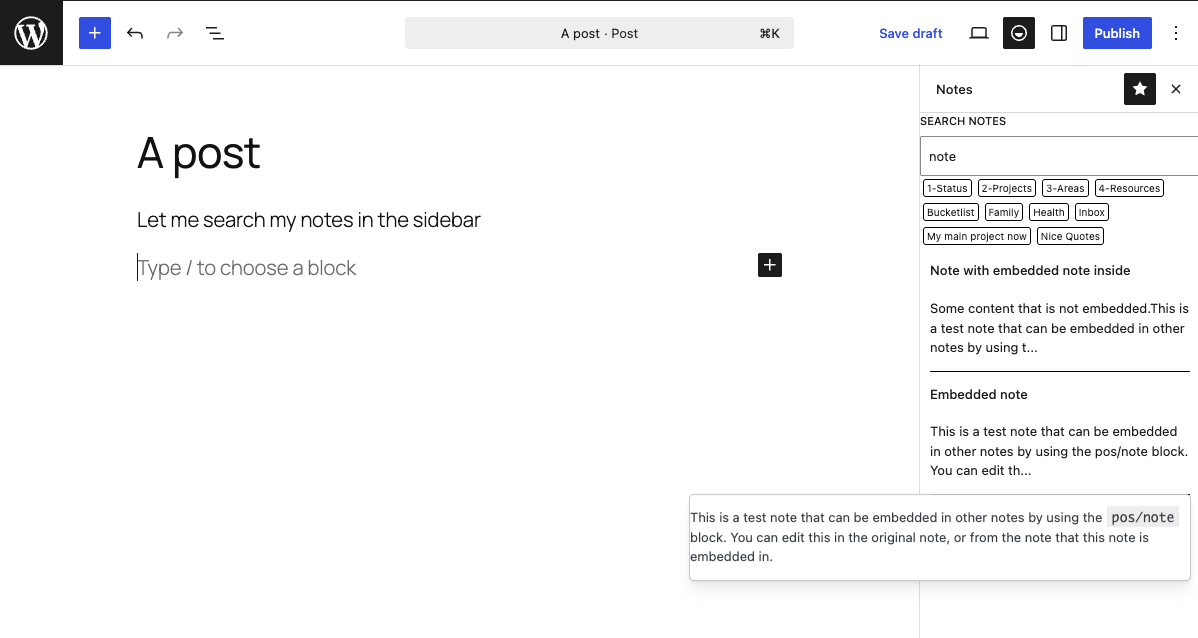
- While composing a new post you could have a sidebar with research as PersonalOS supports
- For a small business or an enterprise, you could have a procedure document and internal instructions tied to capabilities
- or linked to actual actions in WordPress like managing a WooCommerce store
- One search API surfaces your public writing and private notes alike

I promised no AI pitches here, but you could imagine how powerful is the idea of a single indexed, searchable and organized knowledge store for AI-powered work.
New plugins on top of this API
The main reason to introduce Knowledge into Core AI is to kickstart an ecosystem of compatible plugins, all built on top of a single data store. API is both a convenience and a statement:
“We see this use case, we want more of this, it deserves it’s own API”
This API is purposefully lean: It aims to organize similar use cases, ensure security promises and serve as a bootstrap for an entire range of solutions.
Leveraging plugin ecosystem
Technically all of these use cases are possible via plugins, but they are not interoperable until we introduce a standard.
PersonalOS introduces a host of note-taking features, but anybody wanting to extend it has to target PersonalOS specifically. Knowledge seeks to break the data layer definition out of all these plugins so multiple developers can independently ship:
- A sidebar Gutenberg plugin surfacing notes supporting the drafted post
- An Evernote, Readwise, or other service sync implemention plugin
- A backlink plugin that would show notes linking to the current one
- A knowledge graph visualization plugin showing relations between different ideas in the knowledge base
- A myriad of knowledge-base targetted specific features that suddenly can be installed on any WP site to improve note experience.
Shipping a compelling data management plugin on top of WordPress cannot use it’s biggest advantage: the plugin ecosystem. Each plugin uses a propriatary format for it’s data and has to recreate entire feature set from scratch.
Automattic has state of the art knowledge base support with the WordPress-based P2 project. If it was built on top of knowledge, users could pick and choose features they like instead of relying on a proprietary network and installs.
Extensibility beyond plugins
Finally, there is a class of use-cases that depend on a common defined API for storing data: Desktop and Mobile Applications like:
- WP Todo – a mobile TODO manager syncing your iOS Reminders with WordPress
- WordPress Workspace – a desktop utility powerhouse syncing Sticky notes with WP Knowledge
- Using WordPress as Obsidian Sync
With a common API for syncing private data you can tell your user “point this at your WordPress and sync“. The alternative – installing a plugin – introduces enough friction that the developer has no incentive to even start.
But if we already have plugins working with the same API – suddenly there is a reason to create compatible apps, unlocking a new growth opportunity for WordPress.
Leave a Reply